The arms race between automation engineers and anti-bot systems has reached a critical tipping point. In 2023, you could scrape a website using Python and Selenium. In 2024, you needed residential proxies. But in 2026, with the widespread adoption of AI-driven defense systems like Cloudflare Turnstile, Akamai Bot Manager v3, and DataDome, traditional scripting is dead.
If you are still relying on code injection, headless browsers, or simple RPA tools, your "Digital Workforce" is likely spending 90% of its time in a CAPTCHA loop or staring at a "403 Forbidden" screen. The detection algorithms have evolved from checking "Who you are" (IP/Headers) to checking "How you behave" (Biometrics/Intent).
This technical guide explores the only viable path forward: Agentic Workflows powered by Visual Perception AI. We will deconstruct why Promoi AI Workers running on Jumei's Secure Infrastructure can bypass detection that stops 99% of bots.
Why are your traditional scripts failing against Cloudflare and Akamai?
To understand the solution, we must first diagnose the fatal flaws of the old technology stack (Puppeteer, Selenium, Playwright, and standard RPA tools). The failure isn't just in the IP address; it's in the execution protocol itself.
The "CDC" Leak (Chrome DevTools Protocol) Most automation tools control the browser via the Chrome DevTools Protocol (CDC). This is a debugging protocol designed for developers, not for stealth. Advanced anti-bot scripts query the browser environment for specific variables like navigator.webdriver, cdc_, or specific prototype overrides. Even with "stealth" plugins (like puppeteer-extra-plugin-stealth), the latency between the command execution and the browser's response creates a distinct "Machine Signature." AI firewalls recognize this micro-latency pattern instantly.
The DOM Injection Trap Furthermore, these tools interact with the website by injecting JavaScript directly into the DOM (Document Object Model). They search for div id="login" and trigger a programmatic click.
-
The Detection: Modern websites use "Shadow DOMs" and dynamic class obfuscation (e.g., changing
class="btn-primary"toclass="x9f-2k1"on every reload). Code-based selectors break immediately. -
The Red Flag: More importantly, the security system sees the
click()event firing with zero coordinates (0,0) or zero latency. No human clicks a button without moving the mouse first. This is a dead giveaway.
How does "Visual Perception" differ from "Code Injection"?
The only way to bypass behavioral detection is to not behave like a bot code. This requires a paradigm shift from "Scripting" to "Agentic Automation."
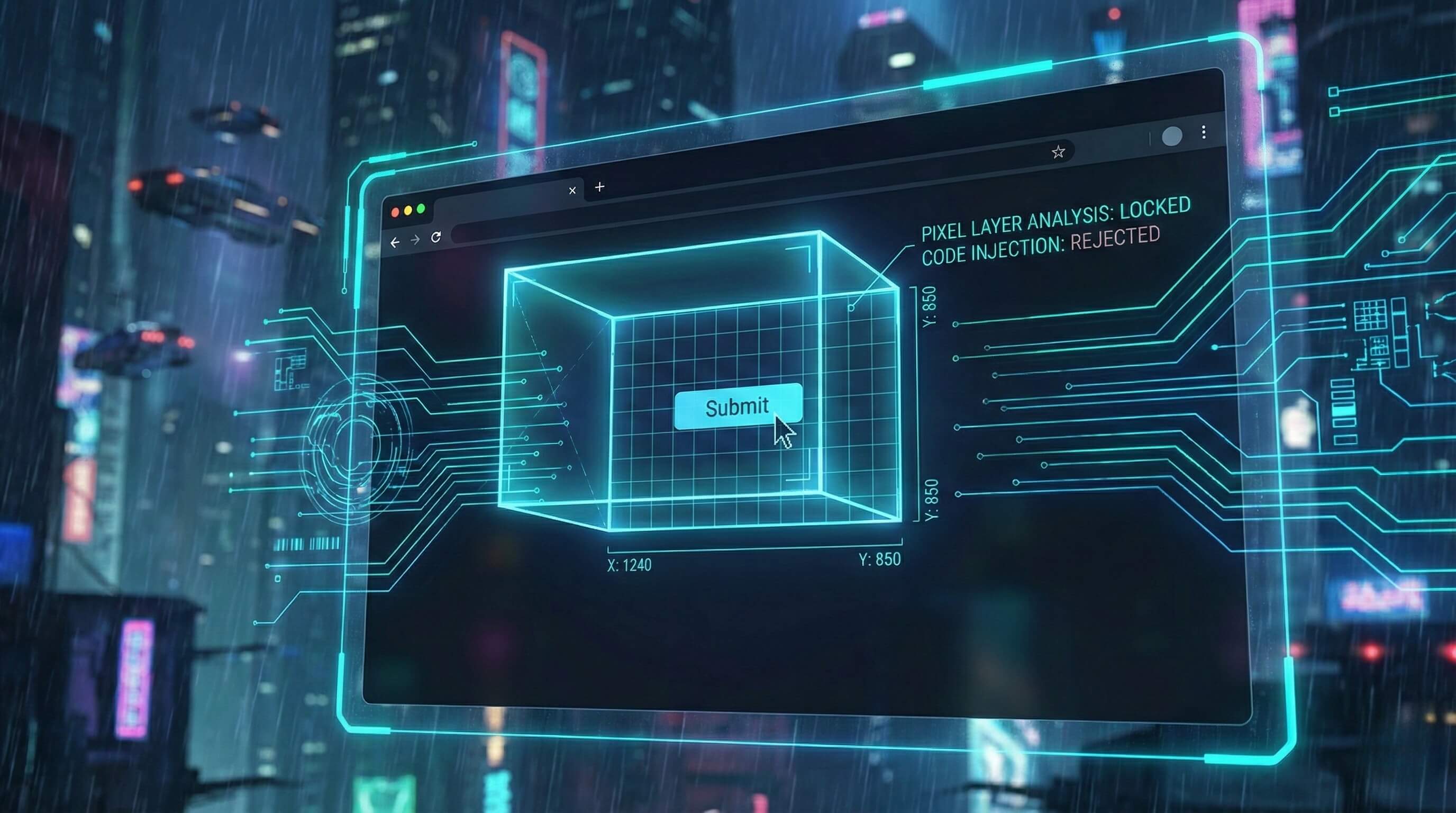
Promoi's Visual AI Engine utilizes a technology called V-LAM (Visual Large Action Model). It does not touch the DOM code. Instead, it operates on the Pixel Layer, just like a human eye.
The Anatomy of a Visual Action:
-
Screenshot Analysis: The AI Agent takes high-frequency screenshots (30 FPS) of the browser viewport running inside Jumei's isolated sandbox.
-
Element Recognition: The specialized vision model analyzes the image. It identifies the "Submit" button not by its code ID (
#submit_btn), but by its visual appearance (a blue rectangle with white text saying "Submit"). -
Coordinate Calculation: The AI calculates the exact X,Y coordinates of the button's center point on the screen.
-
Hardware-Level Input: Instead of injecting a JavaScript
click(), Promoi sends a hardware-level mouse event signal to the Operating System. The mouse moves physically across the screen to the target coordinates.
This "Air-Gapped" approach means the website's JavaScript cannot detect any injected code because there is no injected code. The interaction is indistinguishable from a user using a physical monitor and mouse.
Can AI really mimic human "Behavioral Biometrics"?
This is the hardest layer to crack. Anti-bot companies like BioCatch and BehavioSec analyze Behavioral Biometrics—the subconscious patterns of human movement.
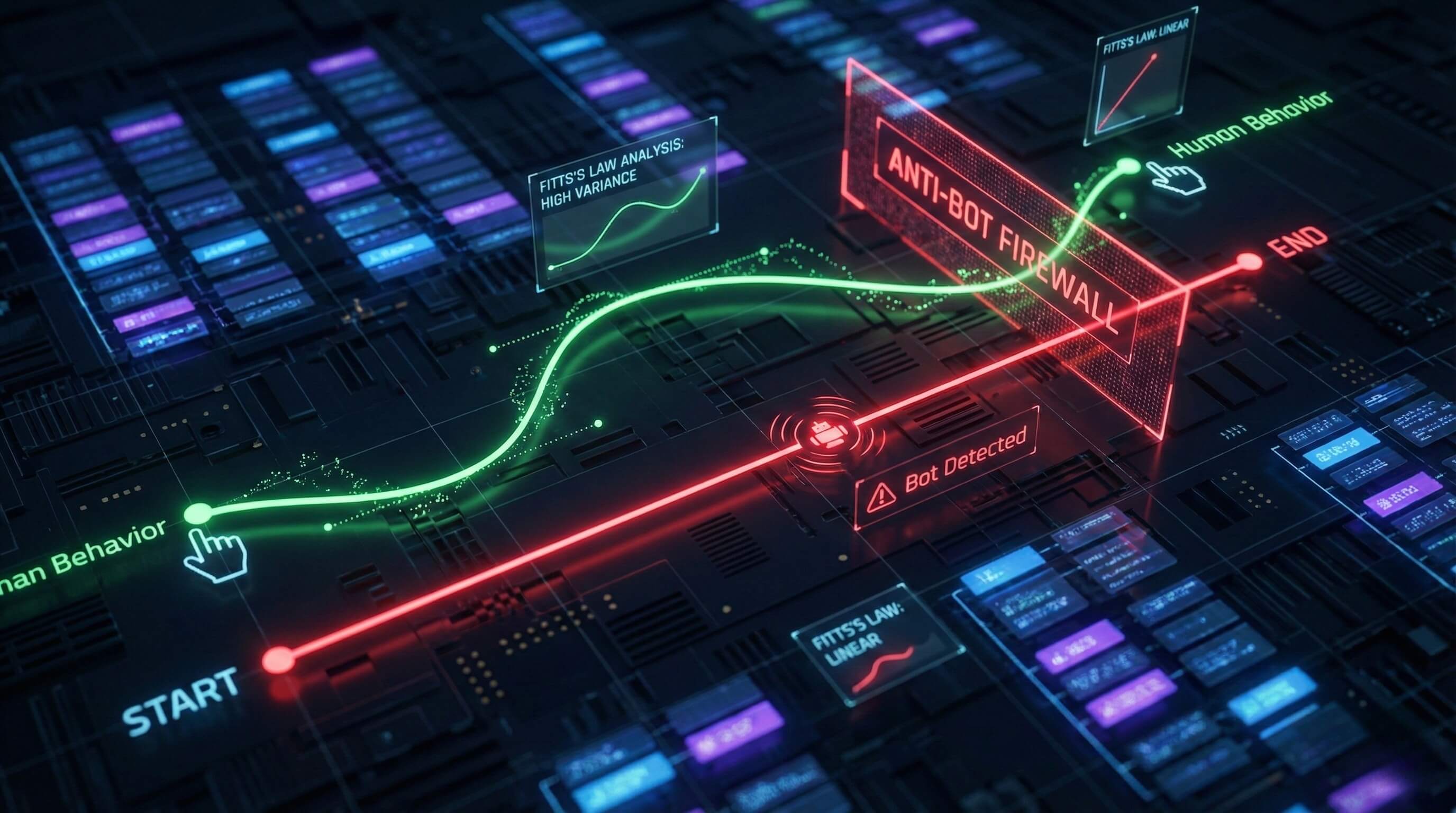
A straight-line mouse movement is mathematically impossible for a human hand. If your bot moves the mouse from Point A to Point B in a perfect line, you are banned.
How Promoi AI Workers defeat this:
-
Stochastic Motion Models: The AI utilizes Bezier Curves to generate movement paths. The mouse cursor travels in non-linear arcs, mimicking the natural pivot point of a human wrist.
-
Micro-Jitters & Overshoot: A real human doesn't stop on a pixel instantly. We overshoot the target slightly and correct. Our hands have micro-tremors. Promoi injects this "Human Noise" into the cursor trajectory.
-
Fitts's Law Adherence: The time it takes to move to a target is a function of the distance to the target and the size of the target. Promoi's movement speed adheres to Fitts's Law, accelerating at the start and decelerating as it approaches the button.
-
Variable Latency: The AI introduces random "Think Time" (e.g., 400ms - 1200ms) before clicking, matching human cognitive processing speeds.
To an anti-bot system, this data stream looks exactly like a human user struggling to find the button, rather than a script executing a command.
Why is the underlying infrastructure (Jumei) just as important as the AI?
Even the most human-like AI will be banned if it runs on a "dirty" environment. You cannot run an AI agent on a standard Linux server or a generic Docker container. Your Browser Fingerprint (Canvas, WebGL, AudioContext) will reveal your identity before you even move the mouse.
The Jumei "Fortress" Architecture:
-
Canvas Noise Injection: Websites ask your browser to render a hidden 3D graphic to identify your GPU. If 1,000 accounts have the exact same rendering hash, they are linked. Jumei modifies the browser kernel to inject invisible noise into rendered graphics, ensuring every AI worker has a unique, persistent hardware fingerprint.
-
Residential IP Binding: We integrate strictly with top-tier residential proxies. Your traffic originates from legitimate ISPs (Verizon, AT&T, Vodafone) rather than data centers (AWS, Azure).
-
TLS Fingerprint Spoofing: When a browser establishes a secure connection (HTTPS), the "Hello" packet creates a fingerprint (JA3/JA4). Standard Python requests have a specific "Python" fingerprint. Jumei's network stack mimics the TLS handshake of a standard Chrome/Windows browser perfectly.
-
WebRTC Leak Protection: Jumei patches the WebRTC protocol to prevent local IP leakage while maintaining valid peer connections, which is crucial for passing deep packet inspection.
For a detailed guide on setting up this secure environment, refer to our Account Survival Strategy Guide.
How to solve CAPTCHAs without using 3rd-party APIs?
The old way of solving CAPTCHAs involved sending the site key to a "Click Farm" API (like 2Captcha) and waiting for a token response. This is slow, expensive, and increasingly detected by "Token Trust" scores.
The Agentic Way (Visual Solving): Because Promoi's AI "sees" the screen, it solves CAPTCHAs agentically:
-
Detection: The Visual AI recognizes the presence of a CAPTCHA challenge (e.g., "Select all traffic lights").
-
Reasoning: It passes the image tiles to a Multimodal Vision Model (like Gemini Vision or GPT-4o).
-
Action: The model returns the coordinates of the correct tiles. The Promoi agent moves the mouse and clicks them physically.
-
Turnstile Bypass: For "invisible" challenges like Cloudflare Turnstile, the system often passes simply because the pre-check mouse movement was sufficiently human-like (curved approach, hesitation), satisfying the "Proof of Humanity" requirement without ever showing a puzzle.
What is the cost of Agentic AI vs. Manual Labor?
One of the biggest questions for enterprise scaling is ROI. Is this technology expensive?
While running a sophisticated Visual AI agent requires more computing power than a simple Python script, it is significantly cheaper than the alternative: Human Outsourcing.
Cost Breakdown:
-
Traditional Script: Cheap hosting ($), but High Maintenance ($$$) and High Ban Rate (Revenue Loss).
-
Human Team: High Salaries ($$$$), Shift Management, Inconsistency.
-
Jumei + Promoi Agent: Moderate Subscription ($$), Zero Maintenance (Self-Healing), Near-Zero Ban Rate.
In high-value workflows like B2B Lead Generation or E-commerce Checkout, the cost of a banned account far outweighs the cost of the infrastructure. Using Jumei ensures your assets (accounts) appreciate in value over time rather than being burned.
Can "Self-Healing" workflows really reduce maintenance time?
Yes. The hidden cost of automation is maintenance. Every time Instagram moves the "Message" button, your Selenium script breaks. You have to hire a developer to update the XPath selector.
Visual AI is Self-Healing:
-
Semantic Understanding: The AI is trained to look for the concept of a "Message Button" (a speech bubble icon or the text "Message").
-
Adaptability: If the platform moves the button from the top right to the bottom left, the AI scans the new page, locates the visual element, and clicks it.
-
Result: Your workflows continue running through UI updates without any code changes. This capability alone reduces operational overhead by 80% for large matrices.
FAQ: Advanced Implementation Questions
Q: Does this work for mobile apps like TikTok?
Yes. Through Promoi's Mobile Use technology, the same Visual AI logic applies to real Android devices in the Jumei cloud. The AI sees the Android video stream and sends touch events (swipes, taps, long-presses) that mimic human fingers. This is the only way to automate TikTok at scale without getting 0 views.
Q: How many AI Agents can I run simultaneously?
This depends solely on your Jumei infrastructure plan. Each AI Agent requires a dedicated "Seat" (either a Cloud Phone or a Fingerprint Browser Profile). If you provision 100 Cloud Phones, you can deploy 100 simultaneous AI Agents. They operate asynchronously, meaning they don't share resources or fingerprints, ensuring maximum safety.
Q: Is this technology legal?
Yes. Agentic AI interacts with public websites using a standard browser, just like a human user. It does not hack APIs, bypass passwords via brute force, or inject malicious code. It is simply a tool that automates the user interface interaction. However, you should always respect the Terms of Service of the platforms you automate.
Stop Fighting the Algorithms. Start Outsmarting Them.
The era of the "dumb bot" is over. To scale in 2026, you need a workforce that is visually intelligent and behaviorally human.
Upgrade from fragile scripts to resilient, autonomous AI Workers. Deploy your first visual agent on Jumei's secure infrastructure today.